


We will get back to you within 1 working day!
Thank you so much for contacting Sojourn Abroad! We can’t wait to welcome you in China!
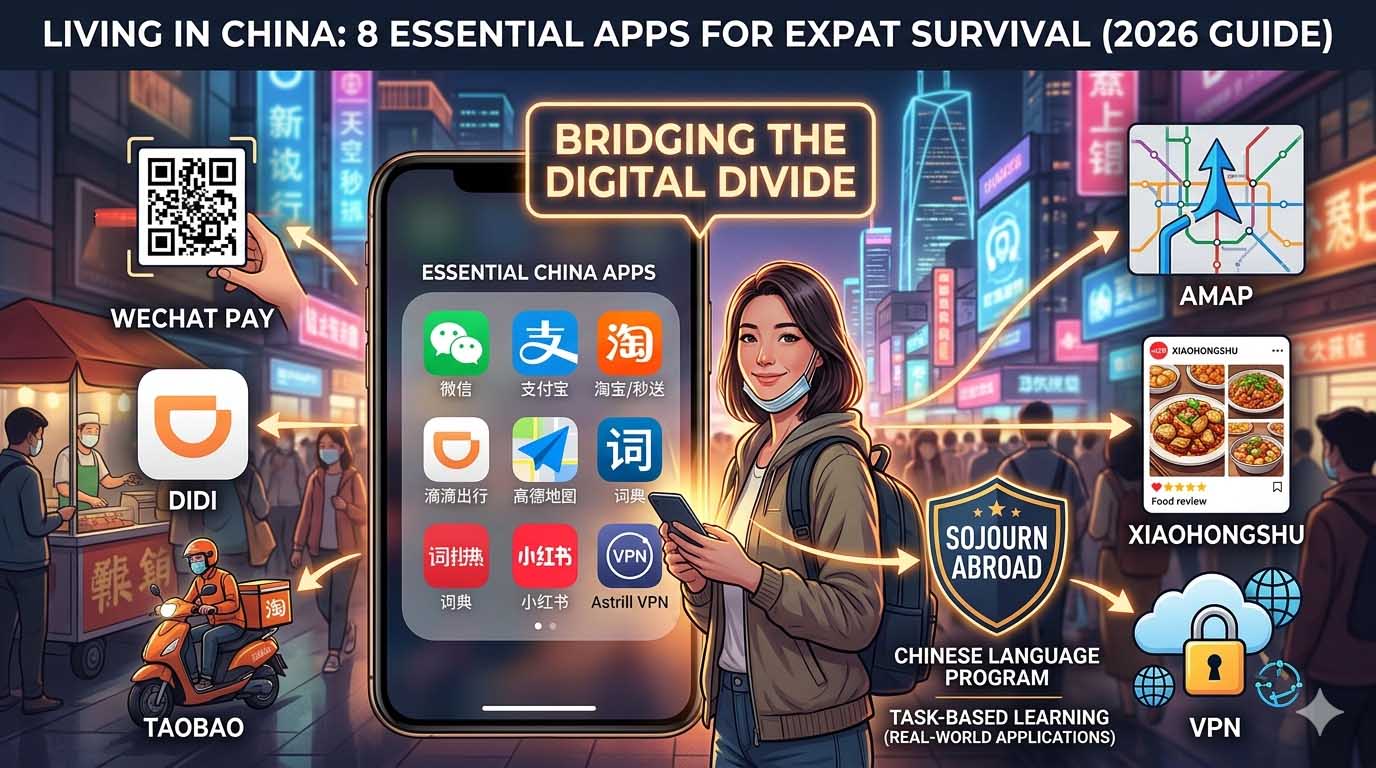
Moving to mainland China—whether for a study abroad semester, a corporate relocation, or a digital nomad stint—presents a unique digital challenge. Due to the Great Firewall, the apps you rely on daily (Google, Instagram, WhatsApp) are inaccessible without specific preparation.
To thrive in China’s hyper-digital society, you must adopt the local ecosystem. This guide covers the 8 essential Chinese apps every foreigner needs, along with the best way to bridge the language gap so you can use them like a local.

WeChat is the primary interface for life in China. It is a messaging app, social media platform, and bank account rolled into one.
Why it’s Essential: You will use it for everything from professional networking to scanning restaurant menus.
Pro Tip for 2026: WeChat now allows foreigners to link Visa and Mastercard directly. However, the most seamless experience comes from having a basic grasp of the language to navigate the “Mini-Programs” (sub-apps for services like laundry or movie tickets).
Practical Strategy: Complete your “Real-Name Verification” in the Wallet section before you land.

While WeChat is for social life, Alipay is the king of utility. It is often more stable for foreign credit cards than its competitors.
Essential Feature: The “Transport” (出行) mini-app. It generates a QR code for the metro and bus systems in almost every city, meaning you never need to struggle with ticket machines.
The Shared Bike Hack: Alipay owns HelloBike. Just tap “Scan” in Alipay to unlock one for a few cents per ride.

In 2026, the shopping landscape has shifted. While the main Taobao app is for traditional shipping, Taobao Flash Purchase (Taobao Miǎosòng) has replaced the old Ele.me ecosystem for instant, 30-minute deliveries.
Why it’s Practical: Whether you need a new laptop charger (Taobao) or a hot latte and a bag of groceries (Flash Purchase), this ecosystem covers it.
Pro Tip: Taobao now has an increasingly robust English search capability for many products, but knowing the specific Chinese terms for your favorite brands is still a massive advantage.
Mastering the Digital Lifestyle: While apps make life easier, the most “practical” tool you can have is language proficiency. Sojourn Abroad’s Chinese Language Program in Kunming specializes in Task-Based Language Teaching. Instead of just memorizing grammar, you learn exactly how to navigate these apps, talk to delivery drivers, and manage your daily life in Mandarin.

Flagging a taxi on the street is nearly impossible today. DiDi is the essential alternative.
Why it’s Practical: The app features a dedicated English interface and automated IM translation. If a driver calls you to ask for your exact location, the app translates your English texts into Chinese for them in real-time.
Safety Tip: Use the “Share Trip” feature to send your live location to a friend through WeChat.

Google Maps is notoriously inaccurate in China due to the “China GPS Shift” problem. Amap is the local solution.
The Killer Feature: Real-time visualization of traffic lights. The app tells you exactly how many seconds are left until the light turns green.
Expats Hack: If your Chinese is limited, use Apple Maps. On iOS, Apple uses Amap’s data but keeps the interface in English.

These are “super-apps” for local services. If you want a coffee, a grocery delivery, or a movie ticket, this is where you go.
Why it’s Practical: Use the “Waimai” (Food Delivery) icon. While the interface is Chinese, the pictures are intuitive.
Pro Tip: Use the “Visual Search” or “Translation Screenshot” method to navigate menus until you’re familiar with your favorite dishes.

Think of this as a mix of Instagram and Reddit. If a cafe has closed or a new visa rule has been implemented, you will hear about it here first.
Why it’s Useful: It’s the most powerful search engine for “lifestyle” in China. Searching for “best coffee in Shenzhen” or “foreigner-friendly gyms” provides visual, crowdsourced reviews that are more current than any blog.

In China, a VPN isn’t a luxury; it’s a prerequisite for accessing your Gmail, work Slack, and news.
The 2+1 Rule: Maintain two paid VPN subscriptions (e.g., Astrill and a backup like LetsVPN).
Critical Timing: You must install and log in to these apps before crossing the border. Once inside the country, access to VPN providers’ websites is blocked.
Apps are the “how,” but the language is the “why.” To truly feel at home in China’s 18+ major cities, immersion is key.
If you are looking for more than just “survival,” Sojourn Abroad offers a unique lifestyle-integrated Chinese program. With small group Chinese classes (under 10 students) and a curriculum that shifts from rote memorization to real-world immersion, they help you navigate the very apps and cultural nuances listed above.
Whether you are in Shenzhen, Beijing, or Kunming, their programs start any Monday of the year, making it the most flexible way to turn your “survival” into “fluency.”
Thank you so much for contacting Sojourn Abroad! We can’t wait to welcome you in China!