


We will get back to you within 1 working day!
Thank you so much for contacting Sojourn Abroad! We can’t wait to welcome you in China!
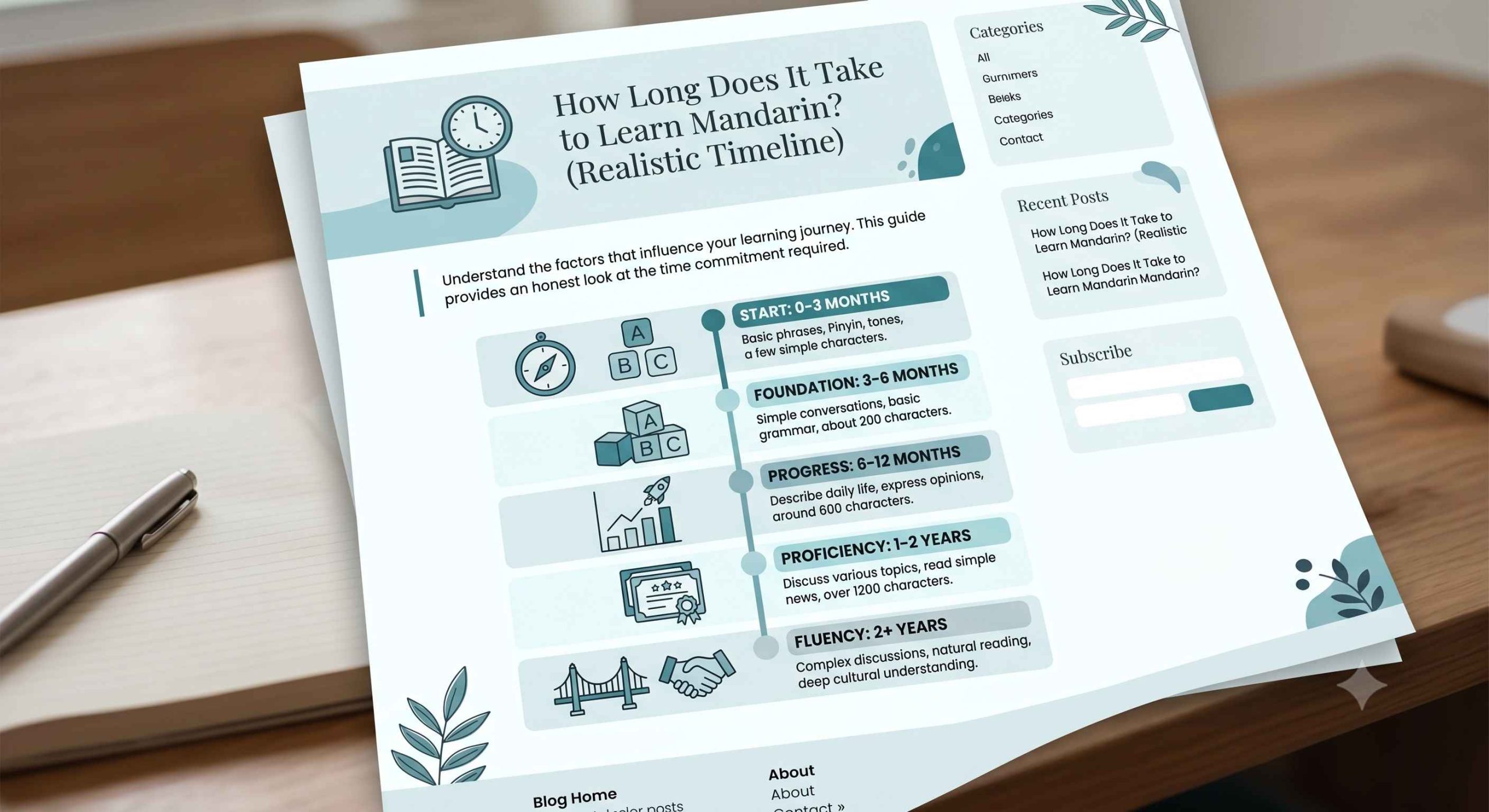
This is one of the most common questions among new Mandarin learners. And the answer, unfortunately, is not simple. It depends on many factors: your native language, how much time you dedicate each day, your learning methods, and your goals.
That said, experienced teachers and language schools have developed reasonable estimates based on classroom hours. This article provides a realistic timeline for different proficiency levels, so you can set achievable expectations for your own learning journey.
Research from the Foreign Service Institute (FSI) places Mandarin in its highest difficulty category for native English speakers. The estimate suggests that reaching professional working proficiency takes approximately 2,200 classroom hours.
This number can feel discouraging at first. But remember that proficiency does not mean fluency. You will be able to communicate long before reaching 2,200 hours. Here is a more practical breakdown.
At this level, you can greet people, introduce yourself, ask for basic information, and handle simple transactions like ordering food or asking for the price.
What you can do:
How to get there: Focus on high-frequency phrases and daily expressions. Practice tones from the beginning. At this stage, memorization is your main tool.
With consistent study of about one hour per day, you can reach this level in roughly one to two months.
At this stage. CEFR A1 describes a learner who can understand and use familiar everyday expressions and very simple phrases. HSK 1 requires approximately 150 vocabulary words and the ability to understand simple sentences. In Sojourn Abroad‘s small group classes of no more than 10 students, teachers focus on high-frequency phrases you will actually use, helping you practice ordering food, asking for prices, and introducing yourself from the very first week. With 15 classes per week, you hear and speak Mandarin daily, which helps you remember these basic phrases naturally, while Kunming’s relaxed environment gives you low-pressure opportunities to try out what you learn outside the classroom.
In the Common European Framework of Reference for Languages (CEFR), the beginner conversation stage described below corresponds to Level A2, often called “Waystage” or “Basic User.” At this level, learners can understand frequently used expressions related to areas of most immediate relevance (e.g., personal and family information, shopping, local geography, employment). They can communicate in simple and routine tasks requiring a direct exchange of information on familiar matters.
At this stage, you can handle simple conversations on familiar topics. You may still make many errors, but you can make yourself understood.
What you can do:
How to get there: Move beyond isolated words and start learning complete sentence patterns. Practice speaking every day, even if only for a few minutes. Listening practice becomes increasingly important.
According to CEFR guidelines, reaching A2 typically requires 180–200 hours of guided learning for European languages. For Mandarin, given its unique writing system and tonal nature, learners often need 150–250 hours of focused study. With one to two hours of daily study, this level typically takes three to five months.
HSK Alignment with CEFR: In the New HSK 3.0 system, the beginner conversation stage aligns closely with CEFR A2. Specifically, HSK 2 expands vocabulary to about 300 words and introduces basic sentence patterns for describing daily life, past experiences, and simple plans. Moving into HSK 3, learners approach the lower range of B1 (independent user), though the core conversational abilities described here fit solidly within A2.
How Sojourn Abroad supports your A2 journey: Sojourn Abroad’s teachers introduce complete sentence patterns rather than isolated vocabulary, helping you move beyond memorization. Regular speaking practice in class builds your confidence, while cultural activities—such as making dumplings during Spring Festival or visiting local markets—give you real reasons to use what you have learned. As a result, you begin to describe your day, ask for directions, and make simple requests without translating from English. This practical approach ensures that you are not just memorizing words for an exam but genuinely reaching the CEFR A2 level of functional communication.


At the elementary level, you can handle most daily situations that come up while traveling or living in a Chinese-speaking environment. You can have short conversations on familiar topics without relying on a translator for every sentence.
What you can do:
How to get there: Regular speaking practice with native speakers is essential. Start thinking in Mandarin rather than translating from English. Increase your listening input with podcasts, shows, or daily conversations.
With consistent daily study of one to two hours, this level usually takes six to twelve months. Many students reach this stage after one semester of intensive study abroad.
HSK Alignment with CEFR: In the Common European Framework of Reference for Languages (CEFR), the elementary proficiency stage described above corresponds to Level B1 (Threshold/Independent User). Within the New HSK 3.0 system, HSK 3 aligns with the lower to middle range of CEFR B1. HSK 3 requires about 600 vocabulary words and the ability to express personal opinions, describe experiences, and handle basic daily conversations with more fluency. Sojourn Abroad organizes teacher-led trips to Kunming’s famous sites, such as the Western Hills and the Stone Forest, turning each visit into a guided language lesson where you practice describing what you see, asking questions about history or culture, and understanding the main points of what local guides or signs tell you. Trying local foods like little-pot rice noodles and flower cakes becomes a natural part of your speaking practice, and you learn to order with specific requests, such as “less spicy,” and to express whether you like a dish.


At the intermediate level, you can handle most conversations with native speakers on familiar topics, although you may still struggle with speed and less common vocabulary.
What you can do:
How to get there: Immersion becomes increasingly valuable. Surround yourself with Chinese as much as possible. Watch shows without subtitles, read news headlines daily, and seek out conversations on varied topics.
For most learners, this level requires one to two years of consistent study. A six-month intensive program abroad can accelerate this significantly.
HSK Alignment with CEFR: In the Common European Framework of Reference for Languages (CEFR), the intermediate level described above corresponds to the range of Level B1+ to Level B2 (Vantage/Independent User). Within the New HSK 3.0 system, HSK 4 aligns with the upper range of CEFR B1 and begins to reach into B2. HSK 4 covers approximately 1,200 vocabulary words and requires the ability to discuss a wider range of topics, express opinions, and understand news or articles on familiar subjects. The flexible duration at Sojourn Abroad—allowing you to stay from 2 to 52 weeks—means you can remain long enough to reach this level without rushing. With long-term student visa support, extended stays are practical. Teachers encourage you to watch local news, read simple articles, and engage in longer conversations on varied topics, and weekend trips to places like Dali or Shangri-La let you book tickets and ask for directions entirely in Mandarin, using the language to solve real problems..
At the advanced level, you can discuss abstract topics, understand fast native speech, and express yourself with nuance. You may still have an accent and occasionally search for words, but you can participate fully in most social and professional settings.
What you can do:
How to get there: At this stage, learning becomes about fine-tuning. Focus on less common vocabulary, cultural references, and subtle differences in meaning. Living in a Chinese-speaking environment is highly beneficial.
Reaching advanced proficiency typically takes two or more years of dedicated study, often including time spent in China.
HSK Alignment with CEFR: In the Common European Framework of Reference for Languages (CEFR), the advanced level described above corresponds to the range of Level C1 to Level C2 (Proficient User). Within the New HSK 3.0 system, HSK 5 aligns with CEFR C1 (Effective Operational Proficiency), while HSK 6 aligns with CEFR C2 (Mastery). At the C1 and C2 levels, learners can understand a wide range of demanding, longer texts, recognize implicit meaning, and express themselves fluently without obvious searching for words. HSK 5 requires about 2,500 vocabulary words and the ability to read newspapers and understand movies or TV shows, while HSK 6 requires approximately 5,000 words and near-native comprehension. Reaching this level takes time and dedication, and Sojourn Abroad’s program allows you to study for up to 52 weeks continuously, with the option to extend. Small group instruction ensures that even at advanced levels, you receive personalized feedback on nuance and cultural appropriateness. Teachers help you fine-tune your pronunciation, understand cultural references, and express yourself with precision through activities like writing spring couplets or discussing festival traditions. Kunming’s welcoming community gives you daily chances to practice with locals who are patient and happy to talk, while the Apartment Hunting Add-on makes settling into the city easier so you can focus entirely on your learning.
A Final Note on Standards: The CEFR (Common European Framework of Reference for Languages) and HSK (Hanyu Shuiping Kaoshi, the official Chinese proficiency test) are two different but complementary systems. HSK focuses specifically on Mandarin and is widely recognized for academic and professional purposes in China. CEFR provides a broader framework used across many languages. The approximate equivalencies above are meant to give you a general sense of where each stage fits. What matters most is not which standard you follow, but that you have a clear path forward. With the right program—one that combines small classes, daily instruction, flexible scheduling, affordable tuition, visa support, and real cultural experiences—you can move through each stage at your own pace. Sojourn Abroad in Kunming offers all of these elements, helping you turn hours of study into real, measurable progress.
The timelines above are estimates. Your personal progress will depend on several factors:
Study consistency.Studying one hour every day is far more effective than studying seven hours once per week. Regular exposure helps your brain retain what you learn.
Learning environment. Living in a place where you hear and speak Mandarin daily accelerates progress dramatically. This is why study abroad programs can compress years of learning into months.
Quality of instruction. Good teachers provide clear explanations, useful corrections, and structured lessons. They help you avoid developing bad habits that are difficult to correct later.
Personal motivation. Learners who enjoy the process and find reasons to use Mandarin regularly tend to progress faster than those who study only because they feel they should.
Many beginners hope to become fluent in three to six months. For most people, this is not realistic. Fluency takes time, and that is okay.
The good news is that you do not need to be fluent to enjoy speaking Mandarin. You can order a meal after a few weeks. You can make a friend after a few months. You can travel independently after one semester. Each level brings its own rewards.
For learners who want to make steady, measurable progress, a structured program with daily instruction can be more effective than studying alone. The consistency, expert guidance, and immersive environment work together to help you reach your goals. Here is how a structured program like Sojourn Abroad in Kunming helps learners move from one level to the next.
The question “How long does it take to learn Mandarin?” does not have a single answer. It depends on your goals, your consistency, and your learning environment.
What matters most is not how fast you go, but that you keep going. Every 30 minutes of study adds up. Every conversation, no matter how short, builds your skills. Every small victory—ordering a meal, asking for directions, making a joke in Mandarin—proves that you are moving forward.
Whether you study for two weeks or a full year, the most important step is the first one.
By Karina
Course Consultant at Sojourn Abroad
Helping you navigate your study abroad journey.
Thank you so much for contacting Sojourn Abroad! We can’t wait to welcome you in China!